
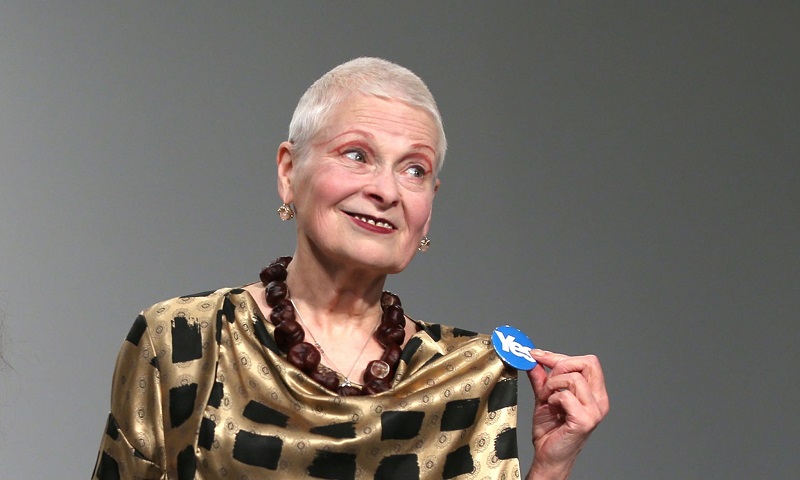
Remembering the Legacy of Vivienne Westwood: A Trailblazer for Truth and Change
In a bustling hotel room in New York City, one spring morning in 2013, I find myself captivated by a photograph of a young soldier named Chelsea Manning. The image, with the word “TRUTH” boldly displayed beneath her tentative smile, is pinned to Vivienne Westwood’s “Climate Revolution” DIY top, resembling the iconic style of artist Barbara Kruger. As I express my unfamiliarity with the subject, Vivienne, accompanied by her husband and artistic director of their fashion label, Andreas Kronthaler, is taken aback. She emphasizes the significance of Manning’s bravery and shares her determination to shed light on the whistleblower’s story.
Vivienne Westwood, an acclaimed fashion designer and activist, has been a prominent figure in the industry for over three decades. During our conversation, we discuss their latest creation, an Amazonian-wild-rubber dress designed for the upcoming Met Gala, as well as the plight of Chico Mendes, an activist who tragically lost his life fighting to protect the rainforest. Vivienne’s intense focus and animated gestures amplify her passion for these causes.
Accompanied by Andreas, who playfully reminds her to wait for him, Vivienne delves into a spirited monologue about Manning’s struggle, her piercing sea-colored eyes aflame beneath the vivid red waves she has painted over them. Throughout her career, Vivienne has fearlessly called out truths, making her visit to New York in April 2013 all the more significant as she accepts Vogue’s invitation to attend the punk-themed Met Gala. Vivienne and Andreas intend to convey their messages to the widest possible audience, with Andreas playfully imagining how he would address the cameras about the rainforest cause.
Hours later, as we walk the red carpet at the Met Gala, Vivienne seizes every opportunity to redirect interview questions towards her accessory of choice—the soldier’s photograph securely fastened to her elegant pink silk coat. In an interview with CNN, she confidently proclaims her support for Manning, emphasizing that it is the most important message she wishes to convey. Vivienne has always viewed fashion as a means of expression, using her platform to address social and political issues. Her daring fashion choices have become legendary—from cosplaying as Margaret Thatcher on the cover of Tatler in 1989 to protesting Julian Assange’s extradition dressed as a yellow canary in 2020.
Vivienne’s activism extends far beyond fashion. Her commitment to causes such as climate change, human rights, and anti-capitalism prompted her to establish The Vivienne Foundation—a charitable organization aimed at saving the world from these urgent challenges. Her ambition knows no bounds.
The depth of Vivienne’s activism is what drew me to her. Our collaborations have spanned various projects, including my donning of a recycled-plastic dress at the Oscars and our joint efforts to raise awareness for climate refugees. Vivienne’s visual activism, which we bonded over, allowed her to communicate profound philosophical and political messages. Punk, for Vivienne, was more than a fashion statement—it served as a vehicle for her ideas, evolving throughout her lifetime while maintaining a steadfast commitment.
Vivienne Westwood’s philosophy was that of an independent thinker, constantly absorbing art, literature, and politics to fuel her creative endeavors. In her later years, she delved into the study of Taoism, finding a sense of clarity and understanding in nature. Andreas, reflecting on their final conversation, emphasized Vivienne’s contemplation of love and her belief that a life without it was meaningless. As we remember Vivienne, her granddaughter


